
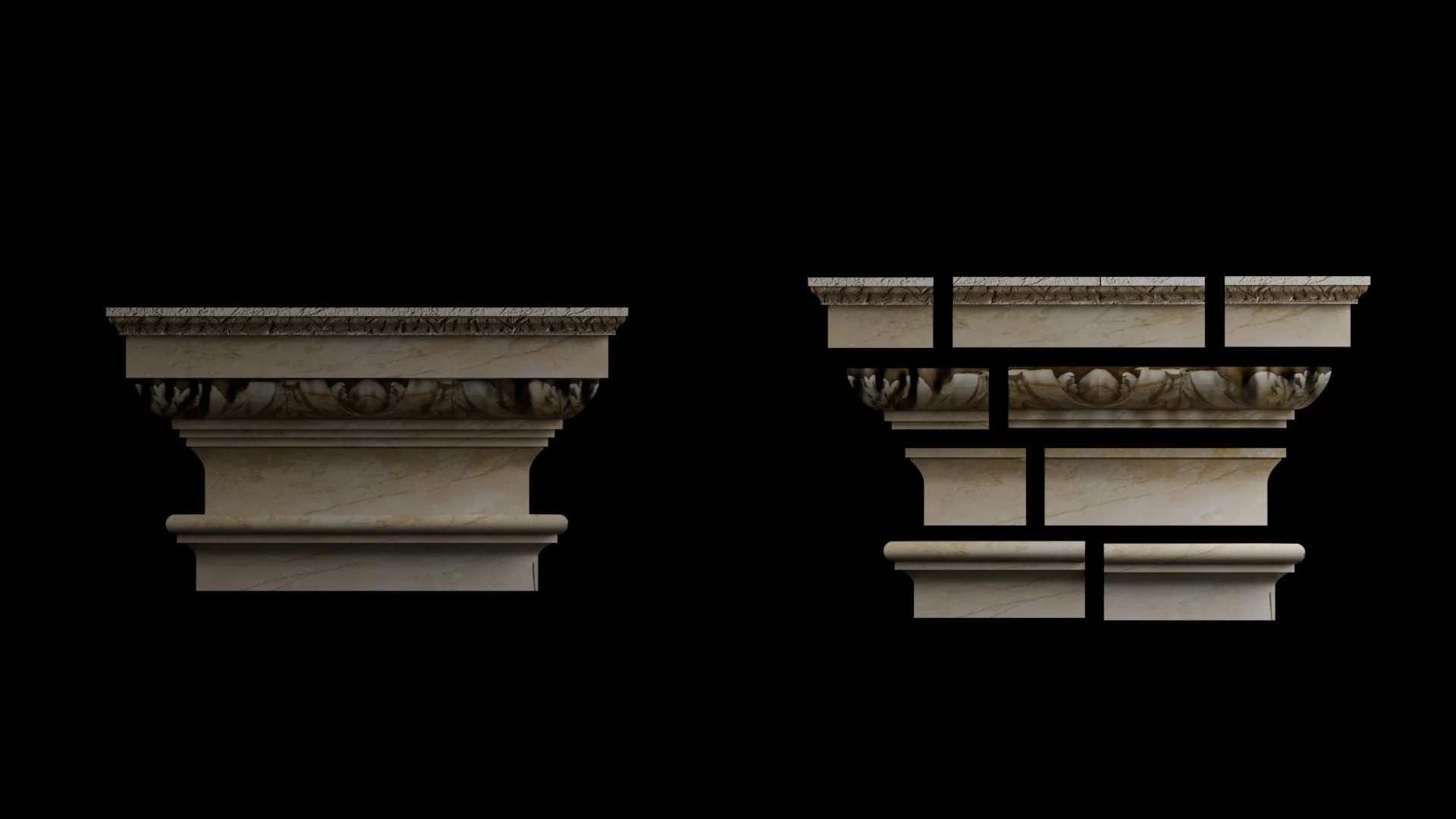
The joints of a Doric pilaster capital on the north front of Castle Howard. Rendering by Andrew Tierney.
Downing College, Cambridge, 27 March 2026
Building Relations: Collaboration, Achievement & Artisanal Agency in Vanbrugh’s Architectural Practice
Melanie Hayes and Andrew Tierney
John Vanbrugh strode into architectural profession with all the nonchalance of a playwright used to summoning new worlds at the stroke of a pen. Except for Hawksmoor, his army of architectural stagehands remain obscure in the grand narratives of architectural history. But as a novice in the profession, he depended on an extraordinary range of skilled artisans who whose knowledge of materials and technique went deeper than the foundations of their buildings. In particular, the monumental scale of works at Blenheim (b.1705) and remote location of Castle Howard (b. 1699) forced Vanbrugh to rely heavily on Hawksmoor’s competence and the rich experience of his master craftsmen. William Etty of York, Clerk of the Works at Castle Howard and Seaton Delaval (b.1718), collaborated closely with Hawksmoor over more than three decades; the Strongs masterminded operations at Blenheim, alongside Henry Joynes and Hawksmoor, from the sourcing and supply of stone to construction and reconstruction of the building’s most challenging elements.
A rich array of contracts, accounts and correspondence, including ‘Mr Vanbrugh’s Book of Derection’s for Blenheim’, chart the close engagementbetween architect and artisan: from the specification of materials, the arrangement of supply and management of performance, to the resolution of problems during construction, all attest to the pressure of the building site. Drawing out the detail of these collaborative relations, this paper presents these great works of architecture not as the sole product of a solitary genius but as the combined effort of architect and artisan working together in collective endeavour.